Showing posts with label History Record. Show all posts

Thursday, October 6, 2011

Attila the Hun plundered a village

Besides who has the time to read history and who cares if some Attila the Hun plundered a village in the fourth century or some king was beheaded by his courtiers? And why bother with what has been over and forgotten, and what is the justification to study something that is unconnected with business issues? After all every modern guru preaches the need to look into the future and not look at the past.And their obvious answers will be the names of some new fangled management book like why the moon is still round while the earth is going flat or the fifteenth leadership habit of a maverick, or some new cutting edge book about managing people, or even some fancy novel.


You will never hear any businessman say they are reading an ordinary book like a medieval or ancient history textbook. Now you may argue where in the world does a boring textbook on history help a businessperson run his or her business.  Common convincing arguments, but you may be surprised to know that reading and understanding history actually has immense business benefits. Hidden inside history lies an immense wealth of advice and real case studies that can not only help every businessman, but practically everyone whether connected with a business or not. But a history book will not help any businessman if read in the traditional way of memorizing events, dates, names, etc., intended to just pass an exam. History is not really some useless stuff as most people think.

History prevents you from reinventing the wheel. Albert Einstein once said, "Insanity is doing the same thing over and over again and expecting different results." Throughout history people have committed the same mistakes of trying to subdue people, wage wars, commit treachery, and various forms of atrocities on each other leading to the same guaranteed disastrous results as experienced earlier. Modern man is no different and even today you see dictators and cruel people ruling many countries and organizations. And similar crimes and follies occur inside workplaces with equivalent disastrous results.

Hence it is highly necessary to read history as it teaches the current generation to understand things that don't work or never worked in the past. If you can understand history in the right perspective it can help the present business managements to avoid needless and futile experimentation with people management. By learning the patterns of events in history, you can recognize the repeat of the same patterns in what is going on around you today.

Wednesday, September 28, 2011

Reich Agent For Fashion


It’s unclear what happened between 2006 and 2010, nor do we know who put the paintings up for auction in 2006 or where they may have been before that. If any arrests have been made or criminal complaints filed, they haven’t been announced.Despite the delay and many missing pieces of this puzzle, Poland’s Ministry of Culture is delighted to have the Falats back. Approximately 60,000 works of art that disappeared from Polish collections during World War II are still missing.

Two important works by Polish impressionist painter Julian Falat that were looted from the Polish National Museum in Warsaw by Nazis in 1944 and then disappeared for over six decades are on their way back to Poland. Representatives from U.S. Immigration Customs and Enforcement (ICE) and the U.S. Attorney’s Office officially returned the paintings to the President of Poland Bronislaw Komorowski in a ceremony at the Polish Consulate in New York City. At the same ceremony, President Komorowski presented the Presidential Medal to ICE Special Agent Lennis Barrois and retired Special Agent Bonnie Goldblatt in gratitude for their efforts in investigating the theft.

In August of 1944, German SS Obersturmbannführer and “Reichsbeauftragter für die Mode” (Reich Agent For Fashion) Benno von Arent took charge of the National Museum in Warsaw and looted the most valuable pieces, including “The Hunt in Nieśwież” and “Before the Hunt in Rytwiany,” two oil-on-panel winter scenes by Julian Falat (1853-1929), a top Polish impressionist painter known for his landscapes. These pieces are considered the finest examples of his hunt-themed work."Those paintings are two magnificent and very important pieces of art,” said Bogdan Zdrojewski, minister of culture and national heritage, Republic of Poland.

"If you think about all the Falat paintings, these two are definitely the most interesting and most valuable ones."The paintings first came to light in New York City in 2006. Polish authorities found out in 2006 that these two masterpieces had been put up for sale at two different New York auction houses. They notified ICE and INTERPOL who conducted an investigation into their history. According to the ICE statement, the US Attorney’s Office for the Southern District of New York filed a civil complaint in Manhattan federal court in December of 2010 asking that the paintings be forfeited on the grounds that they constituted stolen property illegally imported into the United States.

Tuesday, August 30, 2011

Van Gogh found Mystery Stained Glass

In 1876, a 23-year-old Vincent van Gogh was teaching at a small boarding school in Ramsgate, England, and living in Isleworth with the family of the Rev. Thomas Slade-Jones, Congregationalist minister and the school’s owner. It was an unpaid position with a hellish commute. He wrote to his brother Theo of his daily life teaching students Bible history and weeding the garden, of his dreams of becoming a clergyman. This was a period of increasing religious devotion for Vincent. His letters are packed full of his thoughts on Biblical passages, of his desire to spend less time teaching and more time helping Mr. Jones minister to his flock. In a letter to Theo from October 7, 1876, Vincent reported walking almost six hours (!) to London to collect some school fees for Rev. Jones. While roaming the Strand neighborhood, recently rebuilt and now a home to many of the literary and artistic avant-garde, he encountered some old friends and had dinner.
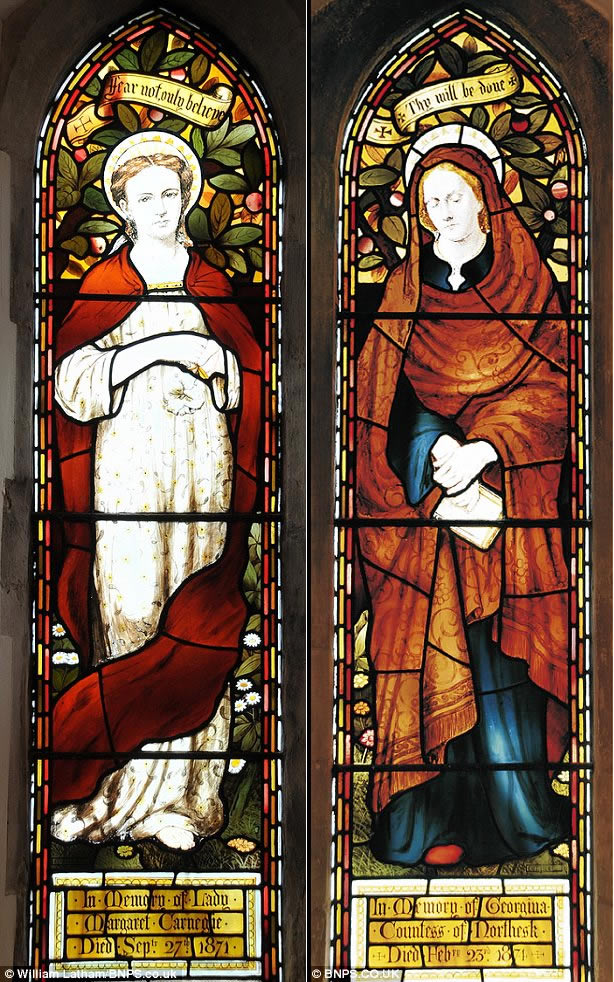
After that I went to [art dealer] van Wisselingh, where I saw sketches for two church windows. In the middle of one window stands the portrait of a middle-aged lady, oh, such a noble face, with the words “Thy will be done,” over it, and in the other window the portrait of her daughter, with the words, “Faith is the substance of things hoped for, the evidence of things not seen.” There, and in the gallery of Messrs. Goupil & Co., I saw beautiful pictures and drawings. It is such an intense delight to be so often reminded of Holland by art.
Van Gogh scholars have long searched for these church windows, and it seems they’ve finally found them in a small church, St. Andrew’s, in Owslebury, near Winchester. The two windows are almost exactly as Vincent describes them, only one inscription — “Faith is the substance of things hoped for” — was changed to “Fear not, only believe” between design and execution.
William Carnegie, 8th Earl of Northesk, commissioned the windows as memorials to his wife Georgiana and his daughter Lady Margaret as older and younger versions of the Virgin Mary. Georgiana died in 1874 at age 63, after 31 years of marriage. Margaret died in 1871 at just 23 years of age. The windows were installed in the church after his death in 1878.
Art historian Max Donnelly found the windows while researching the glazier, Daniel Cottier, and put two and two together in a serendipitous leap.